
Written by Dr. Denise Melton, DVM • Tamberly Animal Hospital • Milton, GA
What arthritis means for your dog—and how we can help.
Your dog pauses at the stairs. They’re slower getting out of bed, or they still enjoy a good afternoon of play but are sore the next morning.
These are changes we want to hear about. You don’t need to wait until your dog has an obvious limp.
At Tamberly Animal Hospital, we’ll examine your dog, talk about what you’re seeing at home, and help you understand what’s causing the difficulty. If arthritis is part of the problem, there are several ways we can help.
Call (678) 459-6001

What is arthritis?
Arthritis means inflammation in a joint. There are different types, but the one we most often discuss in dogs is osteoarthritis, also called OA or degenerative joint disease.
Healthy joints have smooth cartilage covering the ends of the bones. Joint fluid helps those surfaces glide against each other. With osteoarthritis, the cartilage deteriorates, and changes develop in the surrounding bone and joint capsule. The joint can become painful, stiff, and harder to move.
You may hear arthritis described as “worn-out cartilage,” but it affects the whole joint.
Your dog’s muscles, bones, and joints make up the musculoskeletal system. We sometimes think differently about arthritis than we do about heart or kidney disease, but it is also a chronic disease of an organ system. It needs diagnosis, treatment, and regular follow-up.
Arthritis progresses over time. We want to control pain, maintain strength, and slow progression where possible. Starting while changes are mild gives us more opportunity to preserve your dog’s mobility. Even when arthritis is advanced, we still have treatment options to improve comfort and help them get around.
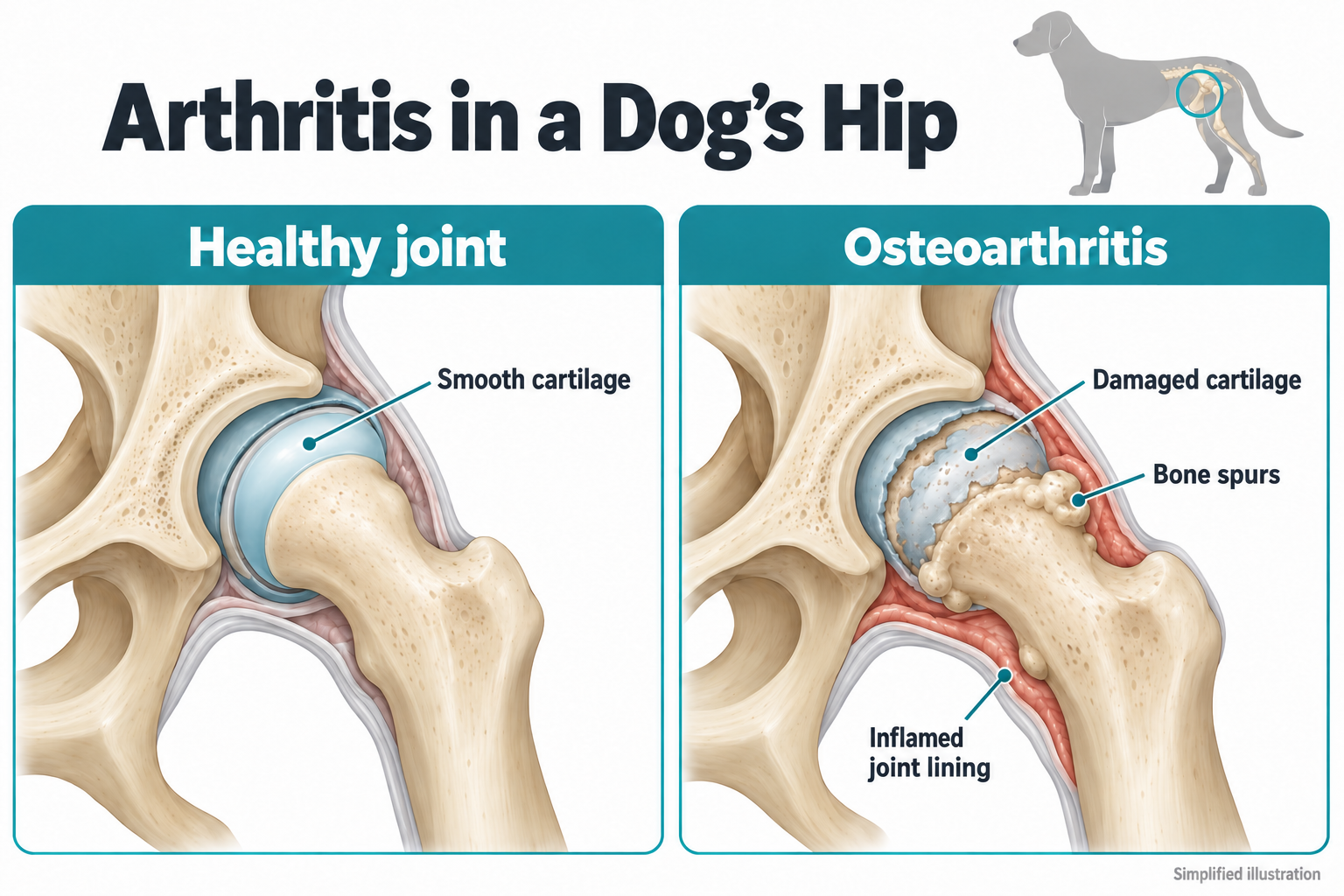
Why do dogs develop osteoarthritis?
Some dogs have joints that didn’t develop normally, as with hip or elbow dysplasia. Others develop arthritis after an injury or because a joint is unstable, as can happen with cranial cruciate ligament disease in the knee.
Young dogs can have arthritis, too. Your dog doesn’t have to be elderly or overweight to have joint disease, although excess weight adds strain to affected joints.
We want to know what led to the arthritis because that may affect treatment. An unstable knee, for example, may need care beyond pain medication.
Signs of Arthritis in Dogs
Some dogs limp. Others change their habits:
- Taking longer to get up after resting.
- Hesitating on stairs or before jumping into the car.
- Walking more slowly or wanting to turn home sooner.
- Playing less.
- Playing hard, then being stiff or reluctant to do much the following day.
- Having trouble settling comfortably into bed.
- Objecting to being touched or picked up.
When these changes happen slowly, it’s easy to get used to them. I often hear from owners after we start treatment that their dog is doing something they hadn’t done in months. Sometimes that’s when we realize how much discomfort had been affecting them.
Tell us about specific changes. “She stopped coming upstairs with us” is helpful information. Short videos can also show us difficulties that don’t happen during the appointment.
How do we know it’s arthritis?
We begin by talking with you and examining your dog, and watching how they walk and turn.
We may recommend X-rays to look for joint changes or investigate an underlying problem. Early changes may not yet be visible on X-rays. They also don’t tell us how much your dog hurts. We consider them together with the examination and what your dog can comfortably do at home.
A dog with arthritis can still develop another problem. If their walking suddenly changes or they develop new weakness, we need to look again rather than assume the arthritis explains it.
Our Mobility & Arthritis Care page describes the evaluation process at Tamberly.
Why do strength and activity matter?
A dog who hurts often does less. Over time, they can lose muscle, making it harder to get up and move around. They may also gain weight, which can make using arthritic joints more painful.
They may compensate by shifting weight away from a painful leg. Other joints and muscles then take on more work. Those changes can lead to additional soreness and may contribute to wear and tear on other joints and soft tissues.
We look at how your dog uses their whole body. Relieving joint pain is important, but we also want to protect existing joint function, help them walk more normally, and maintain or rebuild strength.
We’ll discuss how much activity is appropriate and whether weight management, better traction at home, or rehabilitation would help.
Can arthritis be cured?
We can’t reverse established osteoarthritis. We can treat pain, work to limit its effects and progression, and help your dog stay comfortable and active.
At Tamberly, we want your dog to feel better now and still be able to enjoy their walks and playtime in the months and years ahead. That may mean combining pain relief with strengthening, weight management, or treatment for an unstable joint.
We’ll ask what has improved and what is still difficult. Is getting out of bed easier? Are they sleeping better? Can they finish their usual walk comfortably? Those answers help us decide what to continue and what to change.
These pages explain the treatment options in more detail:
- Dog Pain Management
- [Non-Medication Treatments for Dog Arthritis]
- Laser Therapy for Dogs
- [Platelet-Rich Plasma & Other Joint Injections]
Have you noticed a change?
You can schedule a visit whether your dog already has an arthritis diagnosis or you’re just beginning to wonder why they’re slowing down.
Bring any previous records, a list of medications and supplements, and videos of the difficulties you’re seeing. Tell us what you’d like them to do more comfortably, whether that’s taking a longer walk or simply getting outside without a struggle.
Call (678) 459-6001
Tamberly Animal Hospital • Birmingham Crossroads • Milton, GA
If your dog suddenly cannot stand or walk, has severe pain, or develops rapidly worsening weakness, call right away. If we’re closed, contact an emergency veterinary hospital.